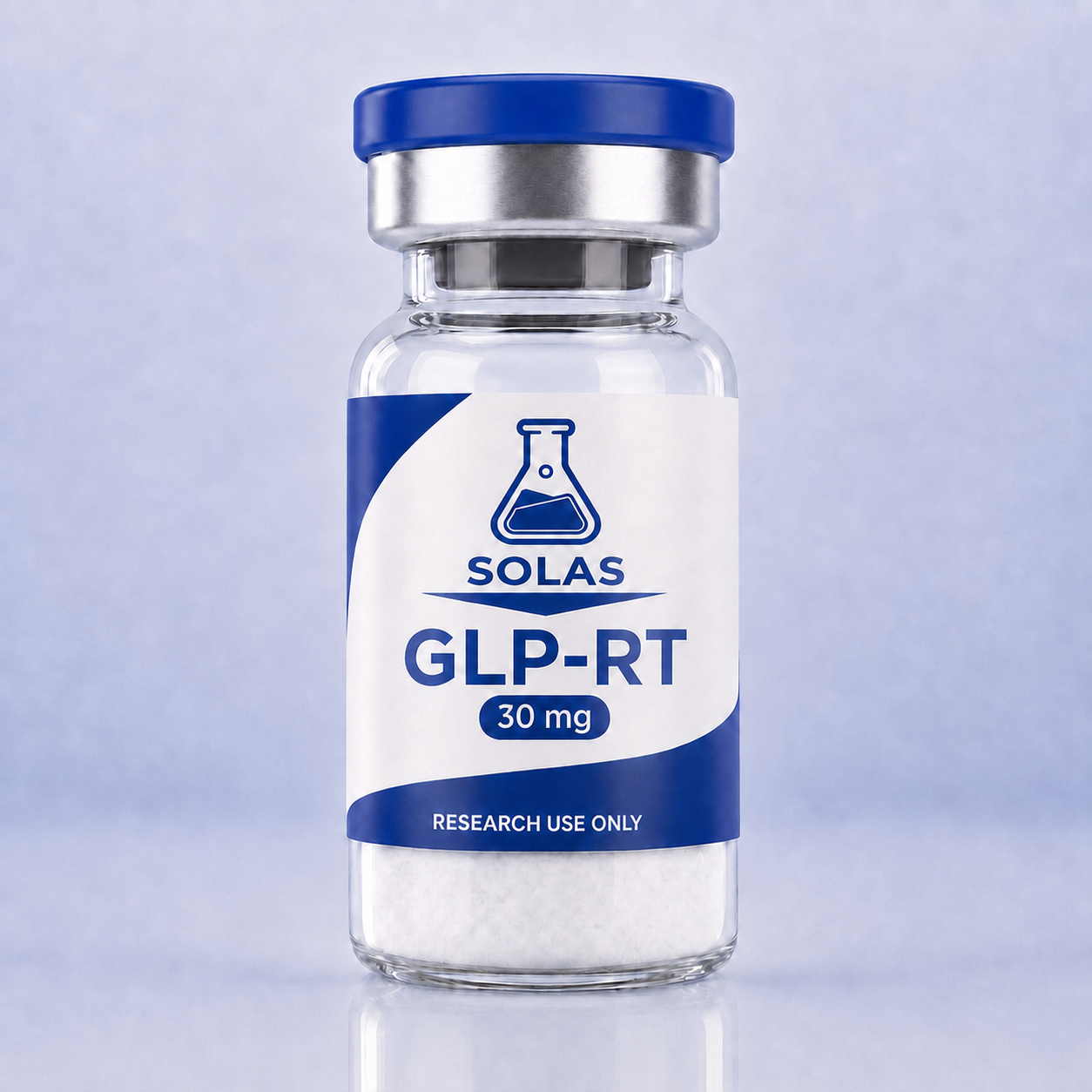
GLP-RT is a synthetic peptide analogue designed for scientific investigation of metabolic signaling pathways, receptor-mediated activity, and energy balance mechanisms in controlled experimental systems.
As research into peptide-based signaling continues to expand, multi-receptor agonist analogues such as GLP-RT are being studied as tools for understanding complex biological networks involved in cellular communication, metabolic regulation, and physiological signaling.
Solasscience provides GLP-RT as a research-grade compound supplied in lyophilized powder form. Each batch is prepared under controlled manufacturing conditions and evaluated to support quality, consistency, and reliability for laboratory and analytical research applications.
For research use only. Not intended for human or veterinary consumption.
What is a GLP-RT Peptide?
GLP-RT is a synthetic peptide analogue developed for research involving receptor-mediated signaling pathways. It is categorized as a tri-receptor agonist analogue, meaning it is designed to interact with multiple receptor systems involved in metabolic and cellular signaling studies.
Researchers use peptide analogues like GLP-RT to examine how receptor activation influences biological communication networks and how different signaling pathways interact within experimental models.
The study of multi-receptor compounds provides researchers with valuable insight into the relationship between peptide structure, receptor activity, and downstream cellular responses.
Scientific Research Areas of GLP-RT
GLP-RT is investigated across several areas of molecular biology, peptide science, and metabolic research.
Metabolic Signaling Pathway Research
Researchers study GLP-RT to better understand signaling cascades associated with metabolic regulation. These investigations examine how receptor-mediated pathways communicate and influence cellular processes under controlled conditions.
Research areas may include:
- Metabolic signaling networks
- Cellular energy regulation pathways
- Receptor activation mechanisms
- Molecular communication systems
- Biological response pathways
Energy Balance Research
Energy balance is regulated by complex interactions between hormones, receptors, and cellular signals. GLP-RT is studied as part of research exploring how peptide analogues may influence these interconnected signaling systems.
Researchers examine:
- Cellular energy-related pathways
- Signal transmission between biological systems
- Molecular responses to receptor activation
- Interactions between multiple signaling pathways
Receptor-Mediated Modulation Studies
One of the primary research interests surrounding GLP-RT is understanding receptor-mediated modulation.
Scientists investigate:
- Receptor binding characteristics
- Downstream signaling activity
- Cellular response mechanisms
- Interactions between different receptor pathways
These studies contribute to broader knowledge of peptide pharmacology and molecular biology.
Why Researchers Study GLP-RT
Multi-receptor agonist analogues provide researchers with opportunities to study how different biological pathways interact simultaneously. GLP-RT research contributes to understanding complex signaling networks that cannot always be evaluated through single-pathway studies.
Exploring Metabolic Biology
Metabolic research involves studying how cells regulate energy use, nutrient processing, and biological adaptation. Peptide analogues such as GLP-RT are investigated as research tools for examining these processes.
Advancing Peptide Research
Synthetic peptides allow researchers to explore relationships between molecular structure and biological activity. Studies involving GLP-RT contribute to the broader field of peptide-based research and receptor biology.
Investigating Cellular Communication
Cells rely on precise signaling systems to coordinate biological functions. Researchers study compounds like GLP-RT to better understand how molecular signals are transmitted and regulated.
Research Applications
GLP-RT may be investigated in laboratory settings involving:
- Metabolic pathway studies
- Receptor signaling research
- Cellular communication models
- Molecular biology experiments
- Peptide interaction studies
- Energy balance research models
- Controlled analytical investigations
Research outcomes depend on experimental design, model systems, and laboratory conditions.
Product Information
| Specification | Details |
| Product Name | GLP-RT Peptide |
| Brand | Solasscience |
| Available Forms | 10 mg – 30 mg |
| Formulation | Lyophilized Powder |
| Product Category | Research Peptide |
| Application | Laboratory and analytical research only |
| Quality Standard | Research Grade |
Frequently Asked Questions
What is a GLP-RT peptide?
GLP-RT is a synthetic tri-receptor agonist analogue studied for research involving metabolic signaling cascades, receptor activity, and cellular communication pathways.
What is GLP-RT used for in research?
GLP-RT is investigated in controlled laboratory studies exploring metabolic pathways, receptor-mediated signaling, and biological response mechanisms.
How is GLP-RT supplied?
Solasscience provides GLP-RT in lyophilized powder form for research and analytical applications.
What does lyophilized powder mean?
Lyophilization is a preservation process that removes moisture under controlled conditions, helping maintain compound stability for research handling and storage.
Is GLP-RT approved for human use?
GLP-RT supplied by Solasscience is intended strictly for research use and is not approved as a human therapeutic product.
Research Use Only
Solasscience supplies GLP-RT exclusively for laboratory research, analytical testing, and scientific investigation.
This product is not intended for human consumption, veterinary use, diagnosis, treatment, cure, or prevention of disease.
Solasscience does not provide dosage recommendations, administration guidance, or instructions for human use.
For research use only.