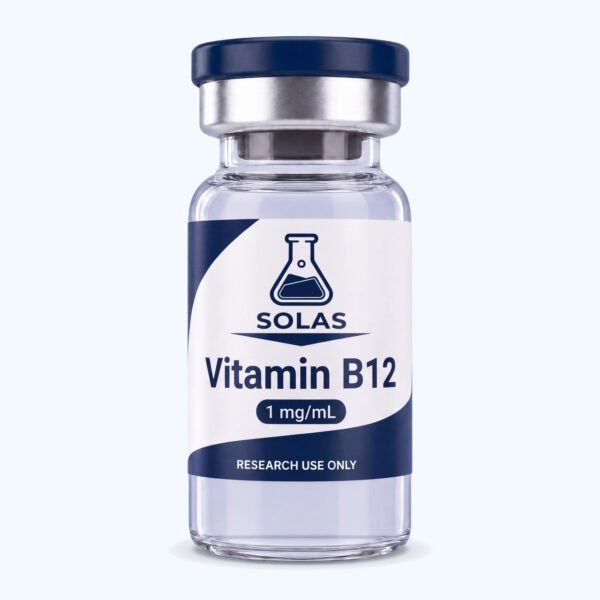
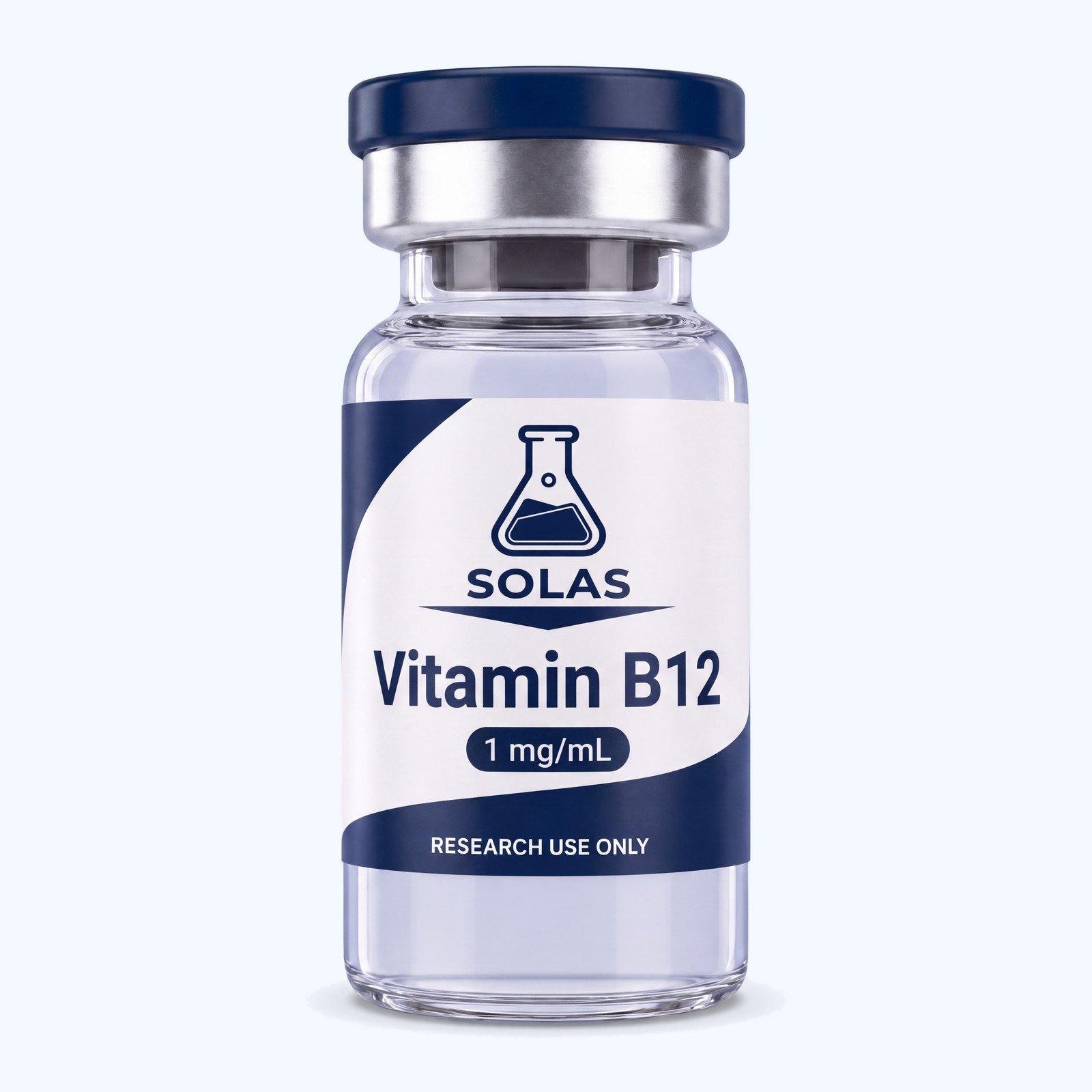
Vitamin B12 (methylcobalamin) is the bioactive, coenzyme form of cobalamin and one of the most widely referenced cofactors in one-carbon metabolism research. Unlike cyanocobalamin, which requires intracellular conversion before it can participate in enzymatic reactions, methylcobalamin is already in the methylated state used directly by methionine synthase.
Researchers investigate methylcobalamin to better understand methyl-group transfer, homocysteine remethylation, mitochondrial substrate handling, and the maintenance of myelinated neuronal tissue in experimental models. Its distinctive deep red color is intrinsic to the cobalt-centered corrin ring and is the visual signature of the intact cobalamin chromophore.
Solas Science supplies Vitamin B12 as a research-grade methylcobalamin solution standardized at 1 mg/mL in a 10 mL vial (10 mg total), prepared under controlled conditions with quality procedures designed to support consistency, stability, and analytical reproducibility.
For laboratory research use only. Not for human or veterinary use. Not a dietary supplement, food, drug, or cosmetic. Not for diagnostic or therapeutic application.
What Is Vitamin B12 (Methylcobalamin)?
Methylcobalamin is a cobalamin in which a methyl group occupies the upper axial coordination site of a cobalt ion held inside a corrin macrocycle. That corrin ring, with its central cobalt atom, is what makes B12 structurally unique among vitamins and what gives cobalamin solutions their characteristic red appearance.
In cellular biochemistry, methylcobalamin serves as the cofactor for methionine synthase (MTR), the cytosolic enzyme that transfers a methyl group from 5-methyltetrahydrofolate to homocysteine to regenerate methionine. Methionine is the precursor to S-adenosylmethionine (SAMe), the universal methyl donor for DNA, RNA, protein, and phospholipid methylation reactions.
The second mammalian cobalamin-dependent enzyme, methylmalonyl-CoA mutase, uses adenosylcobalamin rather than methylcobalamin, which is why research protocols frequently distinguish between the two coenzyme forms when studying cobalamin status and metabolic flux.
Methylcobalamin is photosensitive. Exposure to light drives photolysis of the cobalt–carbon bond, which is the principal degradation pathway for this compound and the reason cobalamin solutions are handled and stored under light-protected conditions in laboratory settings.
Scientific Research Areas of Vitamin B12
Methylcobalamin is investigated across biochemistry, neuroscience, hematology, and metabolic research.
Methylation and One-Carbon Metabolism Research
The most frequently studied application involves methyl-group transfer. Researchers examine:
- Methionine synthase (MTR) activity and cofactor saturation
- The folate cycle and 5-methyltetrahydrofolate trapping
- SAMe / SAH ratios as an index of cellular methylation capacity
- Epigenetic methylation endpoints in cell-culture models
Homocysteine Metabolism Research
Because homocysteine remethylation is cobalamin-dependent, methylcobalamin appears in experimental work on:
- Homocysteine accumulation and clearance in cellular models
- Interaction between cobalamin, folate, and vitamin B6 dependent pathways
- MTHFR polymorphism models and downstream methylation flux
Neurological and Myelin Research
Cobalamin biochemistry is closely tied to nervous-tissue maintenance, making methylcobalamin a reference compound in studies of:
- Myelin sheath composition and phospholipid methylation
- Axonal regeneration endpoints in preclinical models
- Neuronal survival and neurotrophic signaling in culture
Hematopoiesis and Mitochondrial Research
Additional investigative work examines cobalamin-dependent endpoints including:
- Erythroid maturation and DNA synthesis in hematopoietic models
- Methylmalonyl-CoA handling and propionate metabolism
- Mitochondrial substrate utilization under cobalamin-restricted conditions
Product Specifications
- Compound: Vitamin B12 (methylcobalamin)
- Format: Sterile-filtered solution in a sealed glass vial
- Concentration: 1 mg/mL
- Volume: 10 mL
- Total content: 10 mg
- Appearance: Clear deep red solution
- Intended use: Laboratory and analytical research applications only
Quality and Analytical Testing
Vitamin B12 supplied by Solas Science is manufactured under controlled conditions and evaluated through quality procedures designed to support purity, consistency, and reliability for laboratory and analytical research applications.
Quality processes may include:
- Raw material assessment
- Compound identity confirmation
- Purity evaluation
- Sterility testing
- Batch consistency testing
- Controlled manufacturing environments
- Laboratory-grade, light-protective packaging
Product Information
| Specification | Details |
| Product Name | Vitamin B12 (Methylcobalamin) Research Solution |
| Brand | Solasscience |
| Chemical Name | Methylcobalamin (coenzyme B12, mecobalamin) |
| Molecular Formula | C63H91CoN13O14P |
| Molecular Weight | 1344.38 g/mol |
| CAS Number | 13422-55-4 |
| Quantity | 10 mL vial (10 mg total) |
| Concentration | 1 mg/mL |
| Formulation | Aqueous solution, sterile filtered |
| Compound Type | Cobalamin coenzyme / water-soluble vitamin |
| Application | Laboratory and analytical research only |
| Research Area | Methylation, homocysteine metabolism, neurobiology |
| Quality Standard | Research grade, batch tested |
Handling and Storage
Methylcobalamin is light sensitive. Store the vial in its original light-protective packaging, refrigerated at 2–8 °C, and keep it away from direct sunlight, UV sources, and prolonged ambient light exposure. Avoid repeated warming and cooling cycles. Keep the vial tightly sealed and clearly labeled for laboratory inventory, and handle in accordance with standard laboratory safety practice, including appropriate personal protective equipment. Keep out of reach of children and unauthorized personnel.
Research Use Disclaimer
This product is sold strictly for laboratory research use only. It is not intended for human consumption, human ingestion, veterinary use, therapeutic use, diagnostic use, or any in-vivo application in humans or animals. It is not a dietary supplement, food, drug, or cosmetic, and it has not been evaluated by the FDA for safety or efficacy. No statement on this page should be interpreted as a medical claim or as a recommendation for personal use.
By purchasing this product, the buyer confirms they are a qualified researcher or research organization, that they are at least 21 years of age, and that the material will be handled and used only within an appropriate research setting in compliance with all applicable local, state, and federal laws and regulations.